Show summary Hide summary
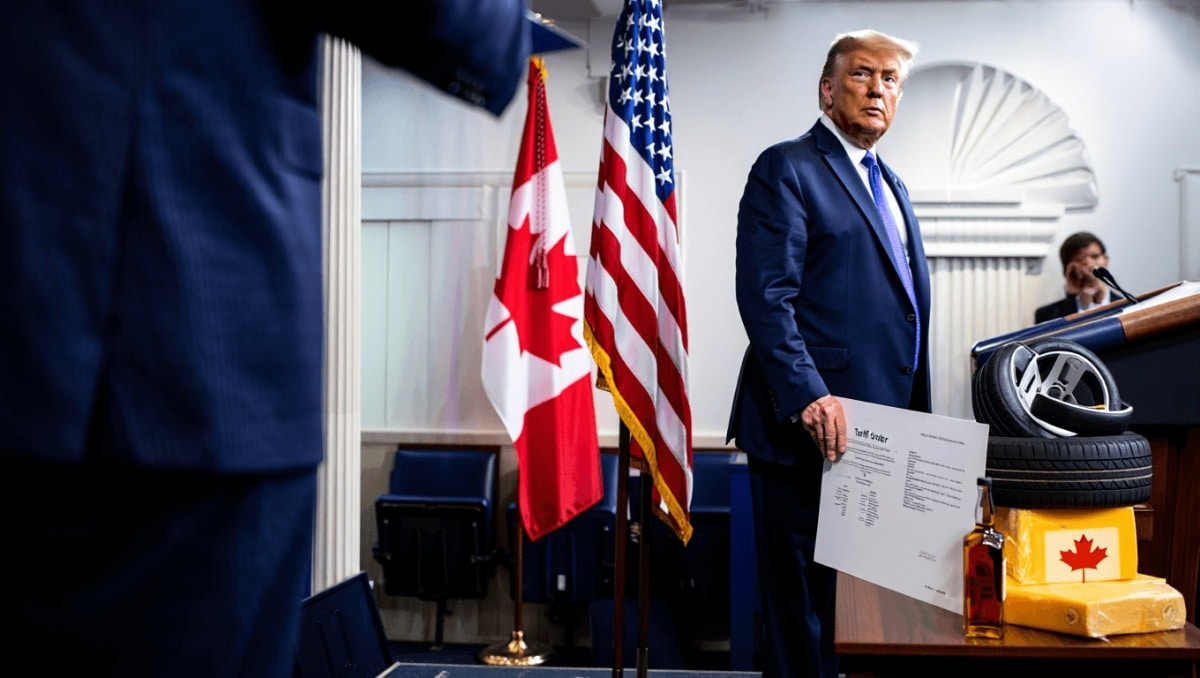
President Trump has ordered steep new tariffs on Canadian imports — a move that could reshape North American trade and lift costs for consumers on both sides of the border. Announced this week, the action uses an old trade statute to impose a 50% levy on many goods, creating a short window for talks while raising the prospect of broader economic fallout.
An administration official, speaking on background, said the president signed three proclamations invoking Section 338 of the Trade Act of 1930 to authorize the duties. The official argued Canada must be held accountable for retaliatory measures it took after earlier U.S. tariffs, and singled it out along with China as a country that responded in kind.
The tariffs — set to take effect in 30 days unless reversed — exclude several categories, including energy, potash, fish and certain critical minerals, but notably cover products that had been shielded under the USMCA trade framework. Administration documents say the move affects a wide set of U.S.-Canada trade flows and opens a negotiation window ahead of implementation.
Kankakee County board spotlights Aroma Park, Asbury UMC and Project Headspace and Timing
Silva vs Delgado shocks Noche UFC: surprise card ends in cascade of stoppages
- Tariff level: 50% on targeted Canadian imports.
- Legal basis: Section 338 of the Trade Act of 1930 (three presidential proclamations).
- Exemptions: energy, potash, fish, designated critical minerals.
- Timing: slated to start 30 days after announcement.
- Scope: includes some goods previously covered by USMCA preferential treatment.
Ottawa responded cautiously. Prime Minister Mark Carney emphasized Canada’s commitment to “free and fair trade” and said his government would engage in intensive negotiations to protect Canadian and U.S. families from higher costs. Provincial and business leaders were more blunt: Ontario’s premier urged matched retaliatory measures, while the Canadian Chamber of Commerce called for swift, constructive talks during the month-long window.
U.S. industry voices also urged a negotiated settlement. The head of the Distilled Spirits Council appealed for restored market access for American producers, warning that family restaurants and bars could be hurt if barriers remain.
Legal and economic analysts warn the choice of authority matters. After the Supreme Court in February found that a prior emergency-based tariff program exceeded presidential powers, the administration turned to older statutory tools to raise import taxes. Some experts say deploying Section 338 in this way is a substantial escalation that could be used against other partners and inject fresh uncertainty into global markets.
“This is a significant legal shift with wide-reaching economic implications,” said one trade economist, noting the potential for reciprocal measures and price effects that will ripple through supply chains.
Political stakes are high. Tariffs directly affect consumer prices because businesses frequently pass import taxes through to shoppers. Democrats in Congress and some business groups warn the levies will raise costs for American families and risk retaliation targeting U.S. industries that the White House says it wants to protect.
The move also complicates the White House’s messaging on the economy ahead of the November midterm elections. Critics point to recent inflationary pressures — partly tied to commodity markets and geopolitical tensions — and say a fresh round of heavy tariffs could deepen public concern about rising prices.
Why Canada was singled out
According to the presidential proclamations, the administration asserts that Canada treats U.S. autos, certain alcoholic beverages and dairy products less favorably than competitors. Washington cites retaliatory Canadian duties, including a 25% tariff on some U.S. motor vehicles that took effect in April 2025, as part of the justification for the new measures.
An administration official also said the president asked aides to study additional penalties related to cross-border environmental impacts, noting Canadian wildfires had affected U.S. air quality — an idea the president had floated publicly.
The two leaders have had tense exchanges since Carney took office. The Canadian prime minister, a former central banker, has spoken out against using economic power as coercion; the president has repeatedly criticized Canadian trade practices in blunt terms.
Possible consequences and next steps
Even if a negotiated resolution is reached in the 30-day window, officials warn the episode could leave lasting damage to bilateral trust and supply chains. If talks fail, observers expect retaliation from Canada and the possibility that other trading partners could be targeted with similar legal arguments.
- Short-term: Higher prices for affected goods and potential supply-chain disruptions.
- Medium-term: Tit-for-tat duties, constrained cross-border investment, and strained diplomatic ties.
- Long-term: Greater unpredictability in trade policy if old statutes are reused against multiple partners.
As the deadline approaches, business groups and political leaders on both sides of the border say they will push for face-to-face negotiations. Whether those talks avert the tariffs or merely delay them will shape trade relations and consumer costs well into the next year.
Several U.S. and Canadian officials are expected to seek urgent discussions; the outcome will determine whether this episode remains a short-lived confrontation or becomes the opening chapter of a wider trade dispute.