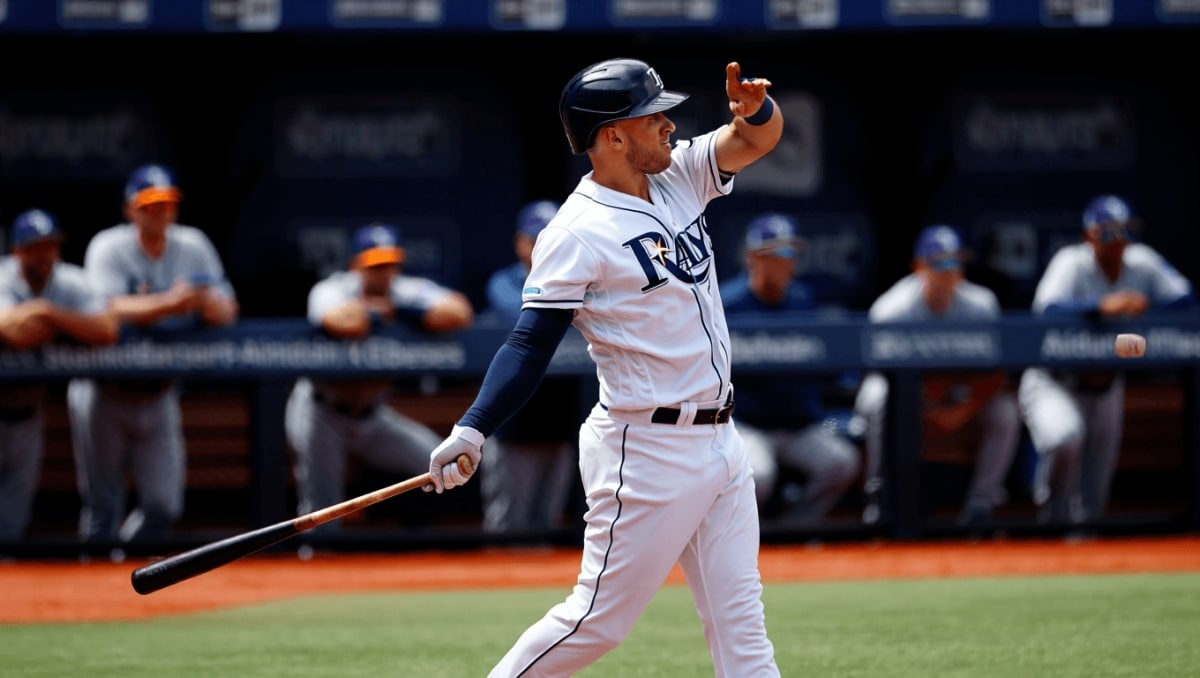
Chandler Simpson has become a flashpoint in baseball conversations this season — praised by traditionalists for his contact-first approach and criticized by analytically minded observers for limited run production. With the 2026 campaign unfolding, the debate matters because how teams value defense and base running versus pure offensive metrics will shape roster decisions this winter.
At face value, Simpson is not the offensive disaster some analytics critics claim. His aggregate hitting numbers place him only slightly below league average, while his contributions in left field and on the bases are clearly above average. Those two facets are central to understanding his overall value.
Statistically, Simpson shows a rare blend: he makes contact at an unusually high rate, strikes out very little (around 8.8% strikeout rate), and produces a lot of well-hit balls. Scouts and traditionalists point to those traits as proof he is doing many of the right things at the plate. Yet the same batter profile brings clear limitations — few walks and a habit of chasing marginal pitches reduce his ability to generate consistent on-base or power output.
Michael Page dropped from UFC rankings despite victory: what it means for his career
Viral video shows 81-year-old delivery worker struggling with heavy luggage
Expected metrics offer a mixed signal. His xBA sits above what he’s actually hitting, while his xwOBA is higher than his observed wOBA, suggesting some positive underlying contact quality but not enough translated offensive runs so far. That gap implies room for either regression or improvement, depending on whether he modifies his approach.
Defense and baserunning are where Simpson’s value is hard to ignore. He’s delivered above-average work in left field and has swiped 11 bags — a contribution that doesn’t always show up proportionally in traditional hitting metrics.
- Strengths: elite contact profile, very low strikeout rate, strong defense in left field, above-average stolen-base production.
- Weaknesses: minimal walk rate, tendency to chase, a larger share of weak batted-ball events compared with power hitters, below-average overall OPS-based numbers this year.
- Underlying data: xBA > actual BA; xwOBA > wOBA — contact quality looks better than surface results in several metrics.
How big is the offensive shortfall? Conventional measures list his OPS+ near the mid-90s (about 95), indicating slightly subpar offensive output. However, if you factor in his impact on the bases — treating steals as the equivalent of extra bases in run-value terms — his offensive profile looks markedly better. Converting his 11 steals into the run-equivalent of doubles would lift his OPS by roughly .100 and push an adjusted OPS+ into the mid-110s, placing him comfortably above average.
That thought experiment is not standard accounting, but it highlights a substantive point: traditional walk-and-power metrics understate players who add value in other, harder-to-capture ways. Teams that overweigh predictive batting metrics may underrate Simpson’s day-to-day impact on winning.
So where does that leave him? If Simpson remains aggressive and continues to put the ball in play as often as he does, his offensive ceiling is limited by the lack of plate discipline. But if he can slightly increase his walk rate and cut down on chasing, the favorable contact profile suggests tangible upside. Meanwhile, his defensive reliability and baserunning give him a floor that keeps him roster-relevant.
For front offices weighing trade or roster moves, the key questions are practical: do you value immediate, incremental run creation through defense and steals more than projected future gains from a patient, power-oriented hitter? Simpson’s 2026 numbers make that decision a live one.
Bottom line: Chandler Simpson is neither a secret MVP nor a liability. He is a multi-tool contributor with clear limits at the plate and distinctive strengths elsewhere. That mix explains the sharp divisions in opinion — and why his role in the majors is likely to persist so long as he keeps delivering on defense and the bases.